Not all fistulas are the same. They are classified based on their path relative to the anal sphincter muscles. Knowing the type is crucial because it determines whether the surgery will be Simple or Complex.
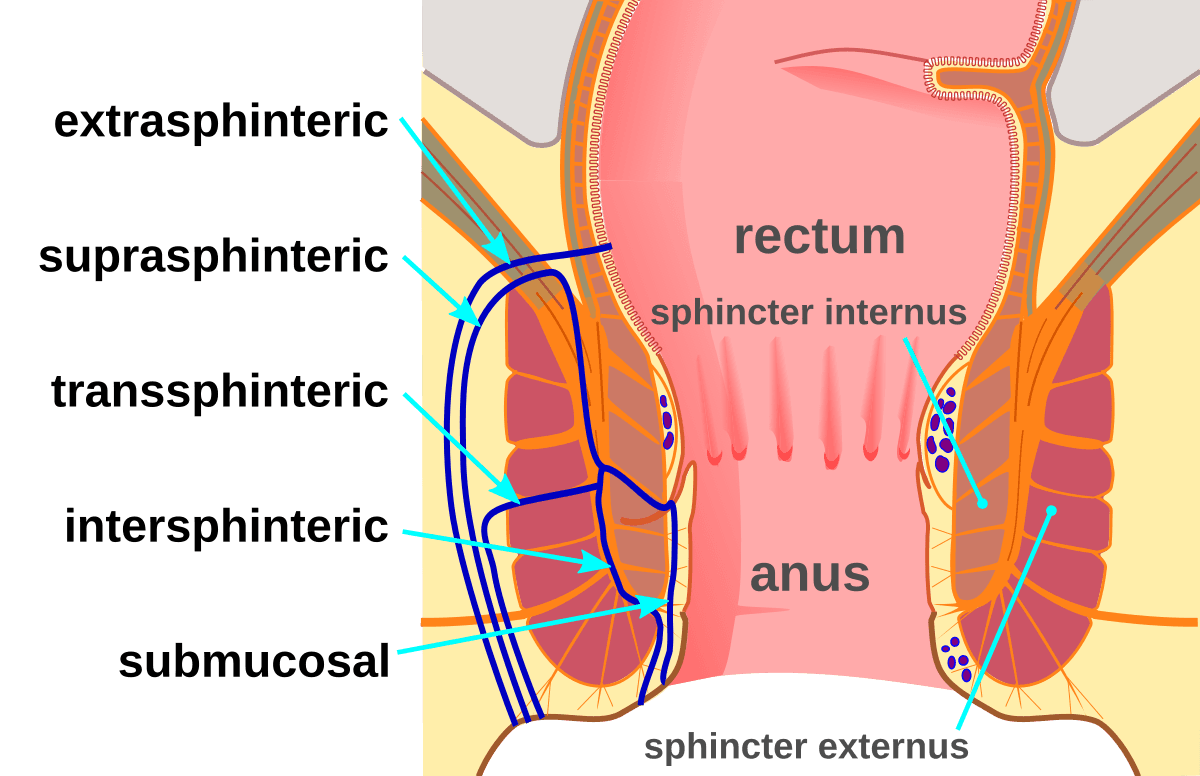 Anatomy Diagram
The main challenge in fistula surgery is to cure the track without damaging the sphincter muscles (which control bowel movements).
Determined by MRI Fistulogram
The track passes between the two sphincter muscles. It is usually simple to treat and has a very high success rate with minimal risk to continence.
The track passes *through* both the internal and external sphincter muscles. Cutting this track openly carries a risk of incontinence, so Laser or VAAFT is preferred.
The track goes *above* the sphincter muscles before opening into the rectum. These are complex and require staged surgeries or Seton placement.
The track bypasses the sphincters entirely, often connecting the rectum to the skin. Usually caused by Crohn's disease or trauma.
Understanding your MRI Report
"Never rush into surgery for a complex fistula without mapping the track. If the muscle is cut wrongly, it can cause lifelong leakage problems."
Dr. Jaya Maheshwari explains what 'Grade' or 'Type' means in your MRI report and why Transsphincteric fistulas require specialized Laser treatment to prevent incontinence.
The type of fistula dictates the treatment. Using a simple "cutting" surgery (Fistulotomy) on a complex fistula can lead to loss of bowel control.
Our Approach
We use sphincter-saving techniques (Laser / VAAFT) for all complex cases.
Send us your MRI report for a second opinion on the type of fistula.
Book Appointment